Good Design Manifesto
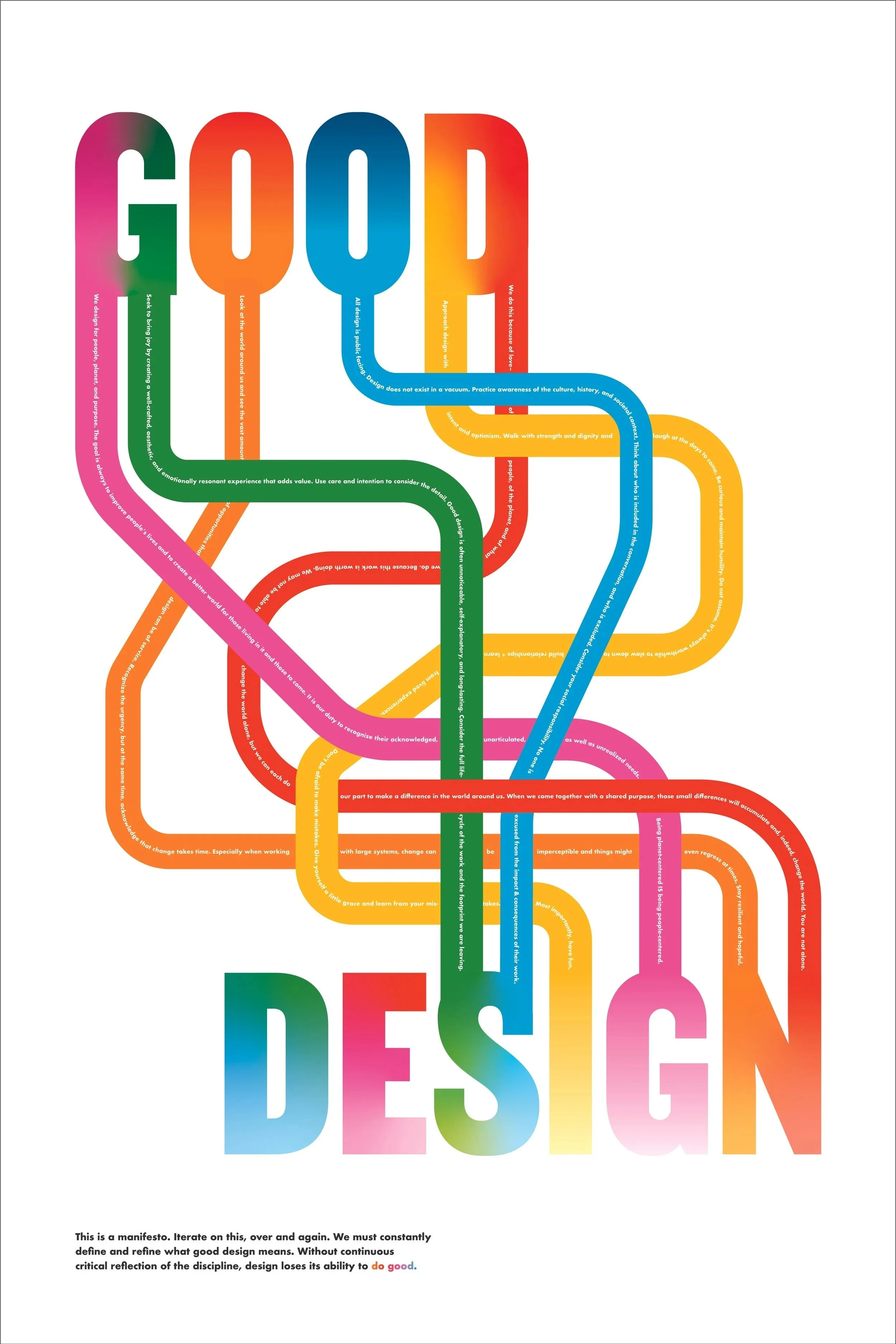
We design for people, planet, and purpose. The goal is always to improve people’s lives and to create a better world for those living in it and those to come. It is our duty to recognize their acknowledged, unarticulated, as well as unrealized needs. Being planet-centered IS being people-centered.
Seek to bring joy by creating a well-crafted, aesthetic, and emotionally resonant experience that adds value. Use care and intention to consider the detail. Good design is often unnoticeable, self-explanatory, and long-lasting. Consider the full lifecycle of the work and the footprint we are leaving.
Look at the world around us and see the vast amount of opportunities that design can be of service. Recognize the urgency, but at the same time, acknowledge that change takes time. Especially when working with large systems, change can be imperceptible and things might even regress at times. Stay resilient and hopeful.
All design is public-facing. Design does not exist in a vacuum. Practice awareness of the culture, history, and societal context. Think about who is included in the conversation, and who is excluded. Consider your social responsibility. No one is excused from the impact and consequences of their work.
Approach design with intent and optimism. Walk with strength and dignity and laugh at the days to come. Be curious and maintain humility. Do not assume. It’s always worthwhile to slow down to build relationships and learn from lived experiences. Don’t be afraid to make mistakes. Give yourself a little grace and learn from your mistakes. Most importantly, have fun.
We do this because of love–of people, of the planet, and of what we do. Because this work is worth doing. We may not be able to change the world alone, but we can each do our part to make a difference in the world around us. When we come together with a shared purpose, those small differences will accumulate and, indeed, change the world. You are not alone.
This is a manifesto. Iterate on this, over and again. We must constantly define and refine what good design means. Without continuous critical reflection of the discipline, design loses its ability to do good.
Click here to download the poster.